
What Is the Most Important Step to Rank a Taxi Business Locally?
By the time we sat down to rebuild West Taxi’s Google Business Profile, the hard research from Part 1 was already done: a full keyword map of every service and location worth targeting, and a competitor audit that showed exactly where the market was weak. And yet West Taxi still wasn’t consistently appearing in Innsbruck’s Map Pack because none of that groundwork had been reflected in the one asset Google leans on most.

How Do You Analyze the Top-Ranking Taxi Companies in Your City?
Before touching a single setting on West.Taxi’s Google Business Profile, we spent twenty minutes doing something almost nobody in the taxi industry bothers to do properly: we studied the three companies already beating them. Not to copy to find exactly where those businesses were vulnerable.

How Do You Choose the Right Keywords and Service Area for a Taxi Business?
West Taxi ranked anywhere, their founder handed me a spreadsheet with exactly one keyword on it: “taxi Innsbruck.” That single phrase was carrying the entire business one word, one location, competing against every taxi company in the city for the same crowded term. Meanwhile, searches like “Innsbruck Airport to Sölden fixed price taxi” and “wheelchair-accessible taxi Innsbruck” were going almost entirely uncontested.

How Does Google Actually Rank Local Taxi Services?
Eight months ago, a small airport transfer company in Innsbruck, Austria. We’ll call them West Taxi was sitting on page three of Google. Zero calls from search, zero bookings from Maps, and a Google Business Profile nobody had touched in over a year. Today, they’re a fixture in Innsbruck’s Local Map Pack, and this series documents exactly how that happened, step by step, so you can do the same for your own city.

The Compounding ROI: What Happens to a Transport Business When You Permanently Own ‘Taxi Transfer in Innsbruck’?
Before we overhauled their search architecture, West.Taxi was trapped in a financial treadmill familiar to thousands of transport business owners across Europe and North America. Every single airport transfer booked from Munich Airport or Innsbruck Airport to the ski resorts of the Tyrolean Alps came at a steep price.

The 5-Star Snowball Effect: How an Automated Review Strategy Fuelled West.Taxi’s Organic Authority
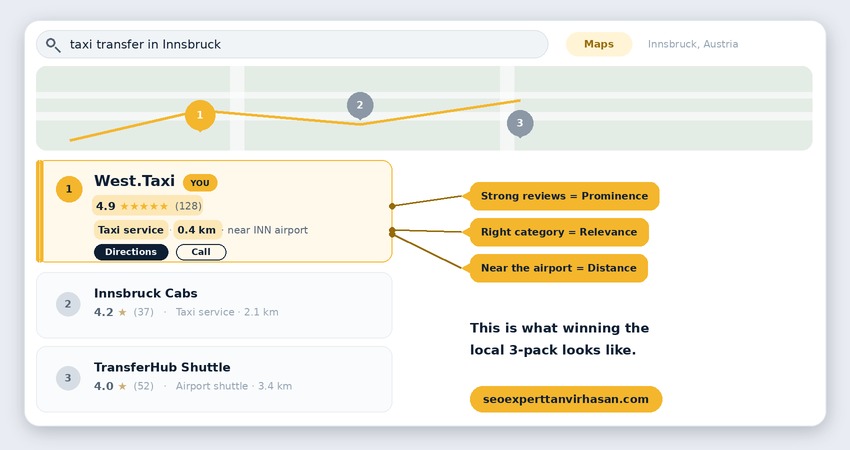
West.Taxi was inside the Innsbruck Maps 3-pack. But the pack isn’t a finish line — it’s a leaderboard, and the businesses at the very top share one thing above all: reviews. If relevance and distance get you into the conversation, prominence keeps you winning it and nothing moves prominence like a steady stream of genuine five-star reviews.
The Map Pack Formula: How We Put West.Taxi’s Fleet on the Digital Map of Tyrol
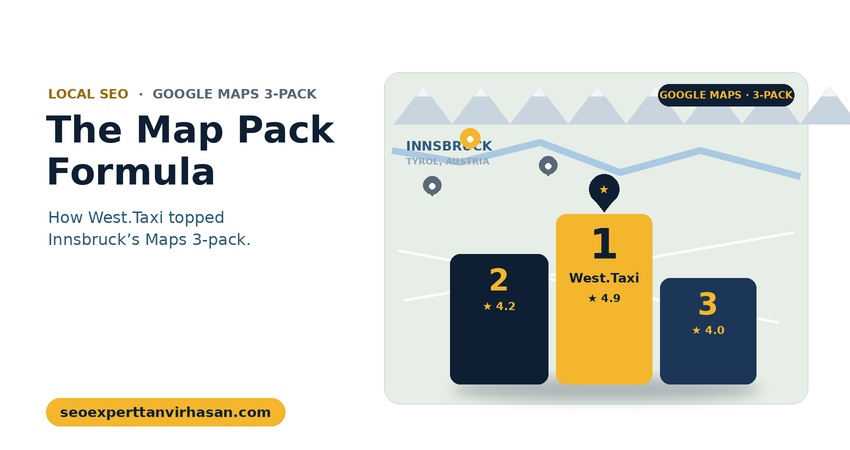
By Part 2, West.Taxi had a fast, schema-rich, bilingual website. But here is a truth every transfer operator learns eventually: for a local taxi business, most bookings aren’t won on your website at all. They’re won in the little box of three businesses Google drops onto a map at the top of the results the Google Maps 3-pack.
There was a twist. West.Taxi’s fleet is based out in Tyrol, yet the searches that matter most — things like “airport shuttle Innsbruck” happen around Innsbruck and its airport. We had to make Google see West.Taxi as an Innsbruck answer while it sat, physically, elsewhere in the region. That is the map pack formula, and it’s more learnable than most owners think. I’m Tanvir Hasan Shawn, a White-hat SEO Expert let’s crack the code.
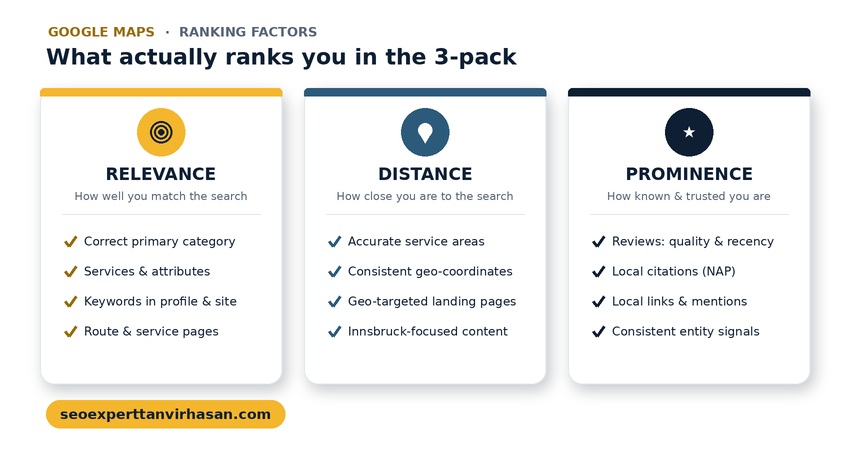
The map pack formula: relevance, distance, prominence
Every Google Maps ranking comes down to three factors, and understanding them turns the 3-pack from a mystery into a checklist:
- Relevance how well your business matches the search. Driven by your primary category, services and the keywords in your profile and on your site.
- Distance how close you are to the searcher or the area they’re searching. You can’t move a mountain resort, but you can define the service areas Google associates you with.
- Prominence how well-known and trusted you are. Built from reviews, local citation building, links, and consistent signals across the web.
You can’t change where a searcher is standing, but you can strongly influence relevance and prominence — and you can shape how Google understands your service area. Every tactic below fits under one of these three levers.
How do I optimize my Google Business Profile for multiple locations?
Quick answer. If you operate across an area rather than from several real storefronts, don’t create multiple listings. Set up one Google Business Profile as a service-area business, define the regions you serve, and optimise that single profile deeply. Genuine separate premises each get their own verified listing; duplicate or fake city listings get suppressed and can trigger a suspension.
West.Taxi is a classic service-area business (SAB): no walk-in storefront, serving customers across Tyrol. So the Google Business Profile optimization looked like this:
- Hid the street address (required for SABs) and instead defined service areas Innsbruck, Innsbruck Airport, Sölden, Ischgl, St. Anton.
- Set the correct primary category (Taxi service) plus relevant secondaries such as Airport shuttle service and Limousine service.
- Completed every field services, attributes, booking links, opening hours, description, and a full set of geotagged photos.
- Kept it active with Google Posts, an answered Q&A, and prompt review replies.
If you genuinely have multiple offices, each real location gets its own profile with its own unique NAP but never spin up listings in cities where you have no true presence. Google’s guidelines are explicit, and the penalty isn’t worth the shortcut.
How do local citations improve Google Maps Pack rankings?
Quick answer. Local citations consistent mentions of your business name, address and phone (NAP) across directories and websites build prominence and confirm your location to Google. Consistent, quality citations raise trust and lift 3-pack rankings; inconsistent or duplicate ones quietly drag them down.
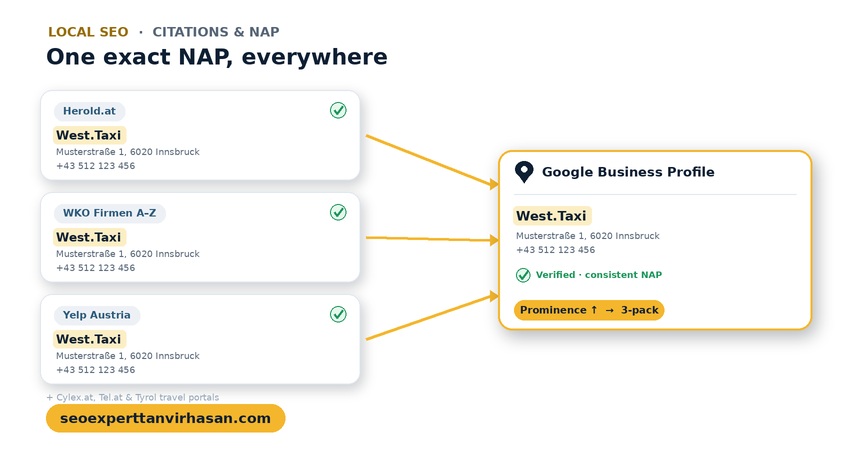
Think of citations as votes of confirmation. Every time an authoritative directory lists West.Taxi with exactly the same details, Google grows more certain the business is real, established, and located where it claims. That certainty is a big part of prominence and prominence is a big part of the pack. Two things matter most: consistency (identical NAP everywhere) and quality (relevant, trusted local and industry sources over spammy volume).
Local citation building in Austria
The citation landscape is country-specific, so “local citation building Austria” means the right Austrian sources, not a generic global list. Our process:
- A full NAP audit first, finding and fixing every mismatched or outdated listing before building new ones.
- Core Austrian directories the major national business directories and maps platforms, listed with identical NAP.
- Local & regional sources Innsbruck and Tyrol directories, tourism portals, and transfer/travel listings relevant to the audience.
- Industry citations taxi, transfer and travel directories that reinforce what the business actually does.
Quality beat quantity throughout. A handful of relevant, authoritative Austrian citations with perfect NAP did far more than hundreds of low-value ones — and left nothing that could be flagged later.
Citations also aren’t a one-time job. New duplicate listings can appear on their own, pulled in by data aggregators, so we set up monitoring to catch and merge or correct them before they fragment the profile’s authority. A clean, consistent citation footprint is something you maintain, not something you finish.
Building Innsbruck authority from a Tyrol base (geo-targeted signals)
This was the real puzzle: ranking for Innsbruck while based elsewhere in Tyrol. The answer wasn’t a trick it was stacking honest geo-targeted SEO signals until Google associated West.Taxi with Innsbruck as strongly as any city-centre operator.
- Service areas set precisely to Innsbruck, its airport and the resort routes travellers search.
- Geo-targeted landing pages dedicated pages for “airport shuttle Innsbruck” and each route, reinforcing the city on the website itself.
- Local links and mentions from Innsbruck entities hotels, ski schools and tourism sites which tie the business to the place in Google’s eyes.
- Location-rich reviews genuine customers mentioning routes (“great transfer from Innsbruck Airport to Sölden”) are among the strongest geo signals there are.
Underneath all of this sits entity SEO: keeping the business name identical everywhere, connecting the profile, website and social accounts with consistent references, and matching geo-coordinates so Google models West.Taxi as a single, trustworthy entity firmly associated with Innsbruck and Tyrol. Managing those localised entity signals is what lets a regional operator win a city’s map pack honestly. We also embedded a Google Map on the contact page, kept the pin and coordinates consistent with the profile, and made sure the Innsbruck-focused pages linked to the routes they described. Individually these are small touches; together they compound into an unmistakable message about where West.Taxi operates which is exactly how a regional fleet earns a city’s trust in the algorithm.

What is the best taxi service in Innsbruck according to Google?
Quick answer. Google doesn’t hand-pick a single “best” taxi. The businesses it shows in the Innsbruck Maps 3-pack are the ones its algorithm rates highest on relevance, distance and prominence usually those with a complete, correctly categorised profile and strong, recent reviews. After this work, West.Taxi became one of them.
It’s worth understanding why this question matters so much now. When a traveller asks a phone or an AI assistant for “the best taxi in Innsbruck,” the answer is pulled straight from the local pack and its reviews. So being seen as “the best” isn’t about claiming it it’s about earning the profile completeness, review strength and consistent signals that put you in the set Google draws its answer from. That is exactly what the map pack formula builds.
The result and what’s next
By the end of this phase, West.Taxi had moved into the Innsbruck Maps 3-pack for its core terms. Profile views, direction requests and calls all climbed the direct, commission-free bookings that come from owning the map rather than renting it from an aggregator.
In Part 4, we deepen the prominence side of the formula with reviews & reputation the ethical review engine that turned first-time passengers into a compounding ranking advantage. But the lesson from cracking the Maps code is this:
In local search you don’t tell Google you’re the best taxi in Innsbruck you give it every honest signal until it concludes that for itself.
If your transport business is invisible on the map in the towns that matter most, that’s fixable. You can book a free visibility audit with me at seoexperttanvirhasan.com.
Google Maps for transport: your questions answered
How do I optimize my Google Business Profile for multiple locations?
If you serve an area rather than run several storefronts, use one profile set up as a service-area business, hide the address, and define your service areas — then optimise that single profile fully. Genuine separate premises each get their own verified listing; never create duplicate or fake city listings, as Google suppresses them and may suspend the profile.
How do local citations improve Google Maps Pack rankings?
Citations are consistent mentions of your name, address and phone across directories and sites. They confirm your location and build prominence — a core Maps ranking factor. Consistent, quality citations from relevant Austrian and industry sources raise 3-pack rankings; inconsistent or duplicate ones weaken them.
What is the best taxi service in Innsbruck according to Google?
Google doesn’t pick one “best” taxi — it shows the businesses its algorithm rates highest on relevance, distance and prominence in the Innsbruck 3-pack, usually those with complete, correctly categorised profiles and strong recent reviews. To be the answer, you have to earn a place in that set.
Can a taxi business rank in a city where it isn’t physically located?
Yes — as a service-area business you can rank in the towns you genuinely serve by defining accurate service areas and stacking honest geo signals: geo-targeted pages, local links and mentions, and location-rich reviews. What you must not do is fake an address or create listings where you have no real presence.
How long does it take to rank in the Google Maps 3-pack?
With a well-optimised profile, consistent citations and a steady flow of genuine reviews, local-pack movement often begins within 4–8 weeks, with stronger positions over three to six months. Competitive city terms take longer than niche route searches.
Under the Hood: The Code, Schemas, and Speed Secrets That Made West.Taxi Lightning Fast for Travellers
In Part 1 of this series, we diagnosed exactly why West.Taxi was stuck on page four and built the blueprint to fix it. This post is where the real building starts the part most business owners never see, because it happens under the hood.
Here is the reality of the transfer market in Europe: a traveller has just landed, they’re tired, they’re on airport Wi-Fi or a weak mobile signal, and they have about five seconds of patience. If your page is slow, confusing, or in the wrong language, they bounce and book a competitor. So before we chased any more rankings, we rebuilt the technical “materials” of the site: the structured data/schema types, the page speed, the mobile UX, and the multilingual setup. I’m Tanvir Hasan Shawn, a White Hat SEO Expert— let’s open the hood.
What is the best schema markup for a local transport company?
Quick answer: The best schema for a local transport company is a combination, not a single type: LocalBusiness / TaxiService for the business itself, Service for each route or offering, FAQPage for common questions, BreadcrumbList for structure, and AggregateRating / Review for social proof all in JSON-LD.
Schema markup is code that tells Google and AI systems exactly what your business is, where it operates, and what it offers. Get it right and you become eligible for rich results (star ratings, FAQs, business panels) and far easier for AI Overviews to quote. For West.Taxi, the Local Business schema markup stack we built included:
- TaxiService / LocalBusiness: name, address, geo-coordinates, telephone, opening hours, priceRange, areaServed (Innsbruck & the Tyrol resorts), and sameAs links to social and Business Profile.
- Service: one entry per core route (airport-to-resort), so each transfer is a machine-readable offering.
- FAQPage: marks up the on-page questions so they can win featured snippets and AI answers.
- BreadcrumbList: clarifies site structure and improves how the URL shows in results.
- AggregateRating / Review: surfaces the star rating that dramatically lifts click-through.
Here is a simplified version of the core markup — the real implementation is more detailed, but this shows the shape of it:
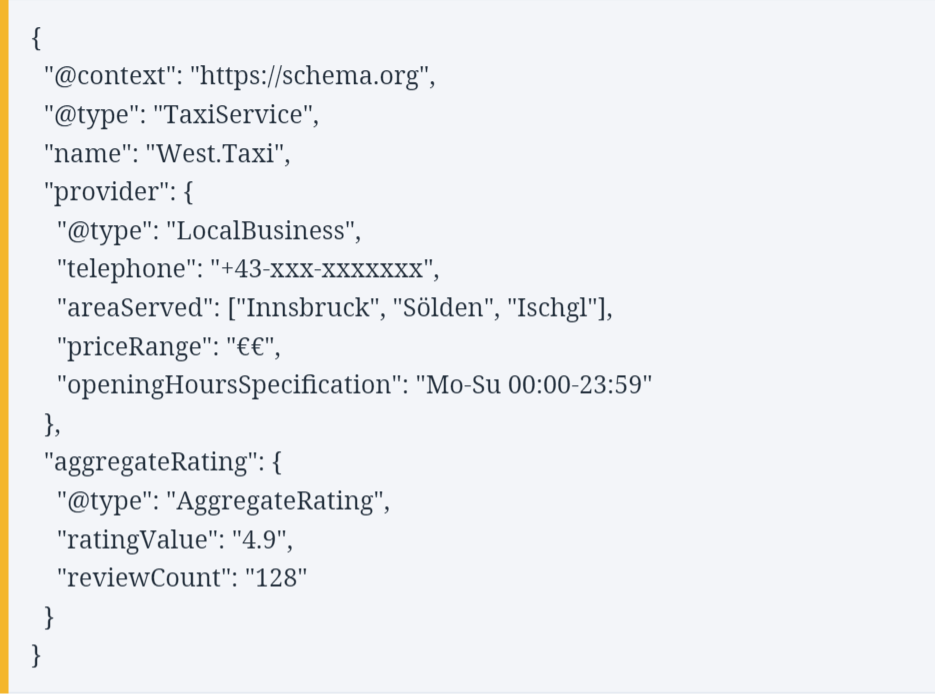
Simplified example. The live markup also includes Service, FAQPage and BreadcrumbList, and is validated in Google’s Rich Results Test before going live.

How does website speed affect taxi booking conversion rates?
Quick answer. Website speed has a direct, measurable effect on booking conversions. Google’s own research shows that as mobile page-load time rises from one to three seconds, the probability of a bounce jumps sharply and for last-minute, high-intent transfer bookers, every lost second is a lost fare.
Speed is not a vanity metric; it is a UX conversion rate lever and a ranking factor at the same time. Google measures the real experience through Core Web Vitals Largest Contentful Paint (how fast the main content appears), Cumulative Layout Shift (how stable the page is), and Interaction to Next Paint (how quickly it responds to taps). Slow or janky pages lose bookings twice: visitors leave, and Google ranks the page lower so fewer arrive in the first place.
For a transfer business the stakes are higher than average, because your customers are overwhelmingly mobile and often in a hurry. A fast, stable page with a tap-to-call button visible immediately can be the difference between a booking and a bounce.
PageSpeed optimisation: the tools and the fixes
To rebuild speed, we measured with real tools and fixed the biggest offenders first. The PageSpeed optimization toolkit:
- Measurement: Google PageSpeed Insights and Lighthouse for lab and field data, plus WebPageTest for a frame-by-frame view of what loads when.
- Images: compressed and served in next-gen formats (WebP), correctly sized, and lazy-loaded below the fold usually the single biggest speed win.
- Code: minified CSS and JavaScript, deferred non-critical scripts, and trimmed third-party tags that were quietly slowing everything down.
- Delivery: browser caching, a content delivery network (CDN) to serve European visitors from nearby, and a faster server response time.
- Fonts & layout: optimised web fonts and reserved space for images to eliminate layout shift (CLS).
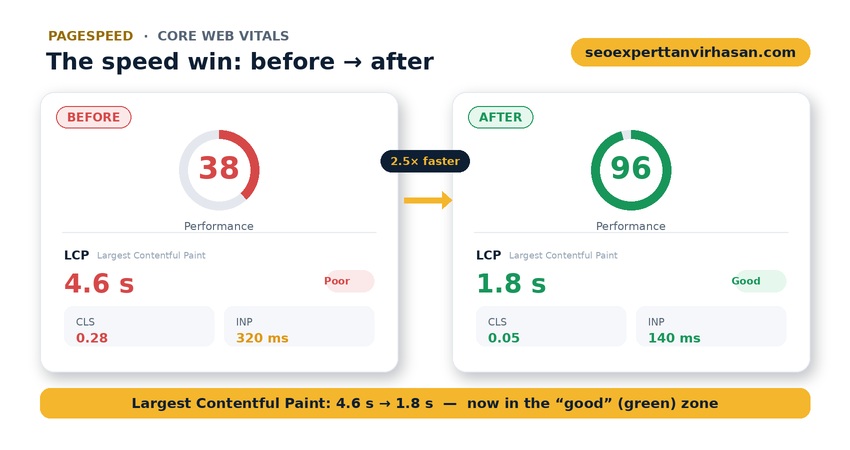
The targets were concrete: LCP under 2.5 seconds, CLS under 0.1, and INP under 200 milliseconds the thresholds Google treats as “good.” Hitting them made the site feel instant on a phone, which is exactly where the bookings happen.
Speed work is never one-and-done. Google indexes the mobile version of your site first, so we tested on real mid-range phones and throttled connections rather than a fast office laptop, and set up ongoing monitoring in Search Console so a future plugin or an oversized image gets caught before it quietly drags rankings back down.
UI/UX layouts that turn visits into bookings
Speed gets people to stay; UX gets them to book. Traffic without conversions is just an expensive vanity metric, so we redesigned the on-page experience around a single question: how fast can a traveller go from “landed” to “booked”?
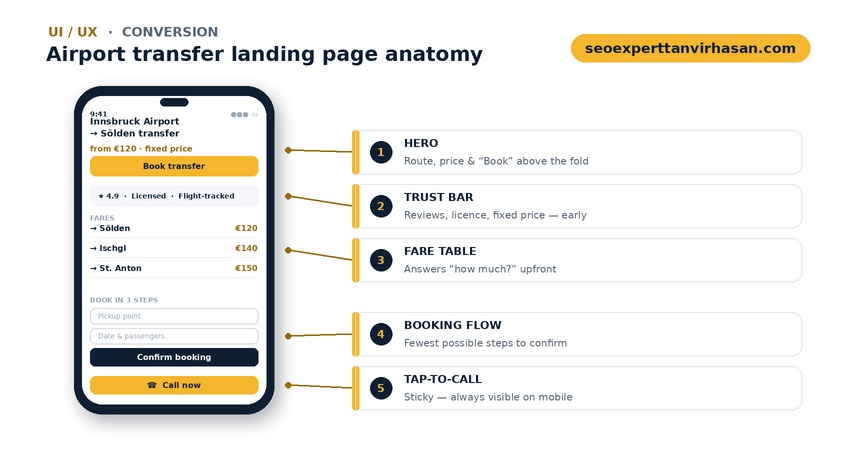
The anatomy of the airport transfer landing page we built for each route:
- A hero that answers instantly: route, fixed price, and a booking button above the fold, with no scrolling required.
- A sticky tap-to-call button: always visible on mobile, because many transfer bookings still happen by phone.
- Trust signals early: star rating, licensing, fixed-price guarantee and flight-tracking, right where doubt would otherwise creep in.
- A transparent fare table: answering the customer’s real question (“how much?”) instead of hiding it behind a form.
- A short, mobile-first booking flow: the fewest possible steps from intent to confirmation.
Each of these choices lifts the UX conversion rate and because the pages are fast and schema-rich, they rank better while converting more of the traffic they earn.
We also removed friction most owners never notice: unnecessary form fields, hidden pricing, and slow confirmation steps. Then we tracked the real journey in analytics where visitors dropped off, which routes converted best so every later change was driven by evidence, not guesswork.
Translation & multilingual optimisation (EN / DE)
Innsbruck’s travellers search in English and German, so a single-language site was leaving bookings on the table. But multilingual SEO done badly auto-translation, or one page trying to serve two languages confuses both users and Google.
We built proper, separately optimised language versions, each targeting how that audience actually searches (for example, “airport transfer” in English and “Flughafentransfer” in German), and connected them with correct hreflang tags so Google serves the right version to the right searcher. Prices, formats and phrasing were localised, not just word-swapped. For any European transport business serving international travellers, this multilingual layer is one of the highest-return technical investments there is.

The impact of the overhaul
By the end of this phase, West.Taxi’s site was fast, stable, machine-readable and bilingual — the technical “materials” were finally worthy of the service. Core Web Vitals moved into the green, the pages became eligible for rich results, and every visit had a clear, quick path to a booking. Rankings and conversions both improved, because for once they were pulling in the same direction.
In Part 3, we take everything above and point it at the map: the Google Business Profile and local-signal work that carried West.Taxi into the Maps 3-pack. But the lesson from this phase is simple:
A beautiful website that loads slowly is a slow website. For travellers booking on a phone, speed and clarity aren’t features — they’re the whole product.
If your transport website feels slow or isn’t turning visits into bookings, that’s fixable — usually faster than you’d expect. You can book a free visibility audit with me at seoexperttanvirhasan.com.
Technical SEO for transport: your questions answered
What is the best schema markup for a local transport company?
A combination in JSON-LD: LocalBusiness or TaxiService for the business, Service for each route, FAQPage for common questions, BreadcrumbList for structure, and AggregateRating/Review for star ratings. Always validate it in Google’s Rich Results Test before publishing.
How does website speed affect taxi booking conversion rates?
Directly. Google’s research shows bounce probability rises sharply as mobile load time grows from one to three seconds, and transfer customers are mostly mobile and in a hurry. Faster, more stable pages (good Core Web Vitals) keep more visitors and convert more of them into bookings.
What are good Core Web Vitals scores for a booking website?
Aim for Largest Contentful Paint under 2.5 seconds, Cumulative Layout Shift under 0.1, and Interaction to Next Paint under 200 milliseconds. These are the thresholds Google labels “good,” measured on real mobile visits.
Do I need separate landing pages for each airport transfer route?
Yes. A dedicated page per route (for example, airport-to-Sölden) matches the exact search intent, lets you show a fixed price, and ranks far better than one generic page trying to cover every route at once.
How should I handle English and German on my taxi website?
Create separate, properly optimised pages for each language — targeting how each audience searches — and connect them with correct hreflang tags. Avoid auto-translation and never mix two languages on one page; localise prices and phrasing, not just the words.
From Page 4 to the Top 3: The Day We Uncovered Why West.Taxi Wasn’t Catching Innsbruck’s Best Leads
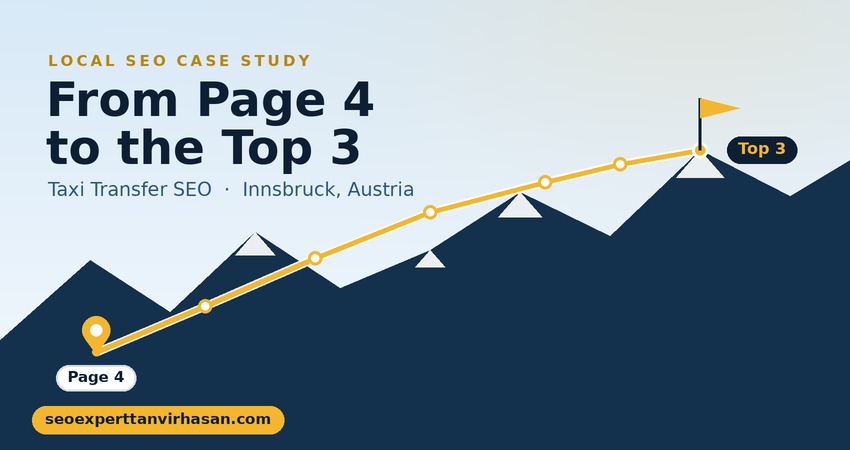
There’s a particular frustration I hear from transport business owners all over Europe: “We’re good at what we do reliable drivers, clean cars, fair prices so why isn’t the phone ringing from Google?” When West.Taxi, a licensed airport-transfer operator in Innsbruck, came to me, that was the exact question on the table.
For their most valuable search the one that turns into a paid airport run they were stuck on page four of Google. And page four, commercially, is invisible. Innsbruck’s best transfer leads were quietly going to competitors and international booking aggregators instead.
This is Part 1 of a case-study series I call The Diagnostics & The Blueprint. Before we could move West.Taxi from page four to the top three, we had to do the thing most agencies skip find out exactly why they were stuck. Not a guess, not a generic checklist: a real diagnosis. Here’s the day we ran it, what we found, and how it became the blueprint for everything that followed. I’m Tanvir Hasan Shawn, a White Hat SEO Expert let’s open the hood.
Why is my transport website not getting online bookings?
Quick answer. A transport website usually isn’t getting online bookings because it’s invisible at the moment of intent it doesn’t rank for the searches customers actually use, its Google Business Profile isn’t competing in the Maps 3-pack, and the few visitors who do arrive hit a page that doesn’t make booking obvious. Bookings leak away in three places: visibility, trust, and conversion.
When I diagnose a taxi or transport site that isn’t turning searches into bookings, the cause is almost always some mix of these:
- It doesn’t rank for high-intent local searches: the route-based and airport-based queries that signal someone ready to book.
- The Google Business Profile is unoptimised: so it never enters the Google Maps 3-pack, where most local transport bookings actually happen.
- The site is slow on mobile: where nearly every last-minute transfer is booked, often from the arrivals hall.
- There’s no clear price, route, or booking action: so even interested visitors give up and tap a competitor.
- Weak reviews and inconsistent business details: which quietly destroy the trust a stranger needs before paying for a ride.
For West.Taxi, it was all five to some degree. The good news: every one of them is fixable and a proper audit tells you which to fix first.
When we started: where West.Taxi actually stood
Before touching anything, I measured the baseline honestly. On day one, the picture looked like this:
- The money keyword “taxi transfer in Innsbruck” sat on page four, far below the fold of demand.
- The Google Business Profile was live but dormant: wrong primary category, thin services, barely any photos, and no presence in the local map pack.
- The website was thin and slow on mobile, with no dedicated pages for the specific airport-to-resort routes travellers search.
Business details (name, address, phone) were inconsistent across directories, and the review base was small and slow-growing.
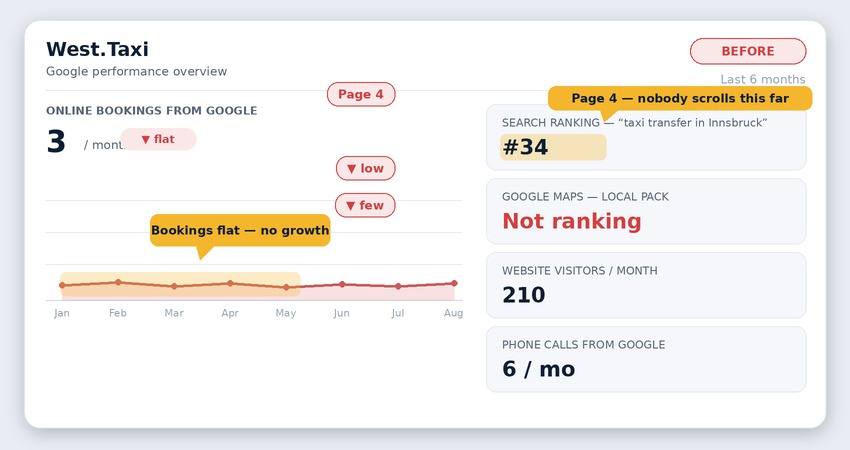
None of this was a reflection of the service quality West.Taxi was a genuinely good operator. It was purely a visibility and trust problem online. That distinction matters, because it means the fix is an SEO problem, not a business problem.
The initial audit: a full local SEO diagnosis
A real local SEO audit isn’t a five-minute score from a free tool. It’s a systematic diagnosis across seven layers, each answering a specific question about why the business isn’t ranking or converting:
- Technical & site health — can Google crawl, render and index the site quickly on mobile? Core Web Vitals, indexation, HTTPS, structured data.
- Keyword & intent gap — what are travellers actually searching, and does the site target those exact intents? (It didn’t.)
- Google Business Profile & Maps — is the profile complete, correctly categorised, and competing in the 3-pack?
- Citations & NAP consistency — do the business details match everywhere they appear online?
- Reviews & reputation — enough recent, genuine reviews, with owner replies?
- Backlinks & authority — are relevant local sites vouching for the business?
- Conversion & UX — once someone lands, is booking or calling effortless?
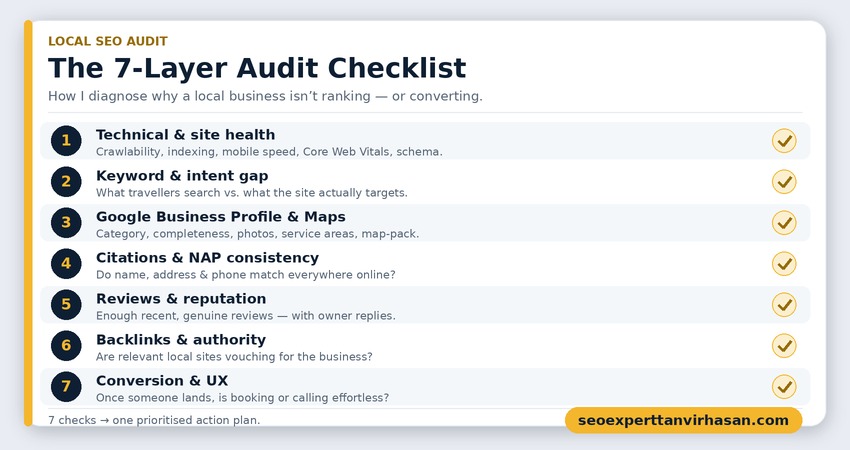
To run it I used Google Search Console and Google Analytics 4 for the site’s real data, Screaming Frog and PageSpeed Insights for the technical layer, Ahrefs for keyword and competitor gaps, and BrightLocal for citation and map-pack checks. The audit turned a vague “we’re not getting bookings” into a precise, prioritised list of causes.
How do I rank my taxi business on Google Maps?
Quick answer. You rank a taxi business on Google Maps by maximising the three signals the local algorithm weighs relevance, distance, and prominence. In practice: choose the correct primary category, complete every field of your Google Business Profile, keep your name, address and phone identical everywhere, and earn a steady flow of genuine reviews you reply to.
Breaking that down into the levers that actually moved West.Taxi:
- Relevance — the right primary category (Taxi service), accurate services and service areas, and a website whose route landing pages reinforce what the profile claims.
- Distance — clearly defined service areas around Innsbruck Airport and the resorts, so Google matches the business to nearby searches.
- Prominence — reviews, consistent citations, and local links that tell Google this is a real, trusted, established operator.

This is also why a great website alone rarely fixes a transport business’s bookings: for local, mobile, last-minute searches, the Google Business Profile and the map pack often decide the booking before anyone reaches your site at all.
Identifying the market gaps (where the opening was)
Diagnosis isn’t only about your own weaknesses it’s about the market’s openings. So I studied who was winning Innsbruck’s transfer searches and why, and where they were beatable.
Two patterns stood out. First, the big aggregators and ride-hailing apps dominated broad, generic terms but they handled specific routes generically, with no local detail, no fixed local pricing, and no real Google Business Profile presence for Innsbruck. Second, the seasonal, tourist-driven, multilingual (English and German) nature of the market meant precise, route-based, bilingual pages were badly underserved.
That was the gap: West.Taxi couldn’t out-spend a global app, but it could absolutely own searches like “airport transfer to Sölden” or “Innsbruck to Ischgl taxi” high-intent, low-competition, and exactly the leads worth having. Market gap analysis is how a smaller local business wins without a bigger budget.
From diagnosis to blueprint
With the audit and market analysis done, the strategy almost wrote itself. Every finding mapped to a prioritised action, in the order that compounds fastest:
- Fix the technical foundation so the site is fast, crawlable and understood.
- Rebuild the Google Business Profile to enter the Maps 3-pack the fastest path to bookings.
- Build route landing pages that match the exact searches travellers use.
- Align citations and grow genuine reviews to build local trust.
- Earn local authority through real partnerships and content.
That sequence is the blueprint — and it’s what carried the money keyword from page four into the top three, with the map-pack visibility and booking calls that came with it. In Part 2, I’ll show you the first build: the technical fixes and the route landing pages that gave West.Taxi a foundation strong enough to rank.
A guess tells you what to try. A diagnosis tells you what to fix — and in what order. That’s the whole difference between SEO that works and SEO that burns budget.
If your transport or taxi website isn’t pulling the bookings your service deserves, the first step is the same one West.Taxi took — a proper diagnosis. You can book a free visibility audit with me at seoexperttanvirhasan.com.
How do I rank my taxi business on Google Maps?
Maximise the three local ranking signals — relevance, distance and prominence. Set the correct primary category (Taxi service), complete your Google Business Profile, define your service areas, keep your name/address/phone identical across the web, and earn steady genuine reviews you reply to. Reinforce it all with route-specific pages on your website.
Why is my transport website not getting online bookings?
Usually because it’s invisible at the moment of intent: it doesn’t rank for the local, route-based searches customers use, the Google Business Profile isn’t in the Maps 3-pack, the site is slow on mobile, or the booking action isn’t obvious. Bookings are lost across three areas — visibility, trust and conversion — and a local SEO audit shows which to fix first.
How long does it take to rank a taxi or transport business locally?
In competitive European markets, expect early movement in three to four months and strong top-five and map-pack rankings around the six-month mark, when the work is white hat and consistent. Map-pack gains from a well-optimised Google Business Profile often show first.
What is a local SEO audit and what does it include?
A local SEO audit is a systematic diagnosis of why a local business isn’t ranking or converting. It covers technical site health, keyword and intent gaps, Google Business Profile and Maps, citation/NAP consistency, reviews, backlinks and authority, and on-site conversion — ending in a prioritised action plan.
Should transport companies rely on Uber, Bolt or aggregators for bookings?
They’re useful for fill-in demand, but they take a commission on every ride and own the customer relationship. Ranking your own website and Google Business Profile earns direct, commission-free bookings and repeat customers you keep — which is why owning your local search is worth the investment.
Avoid These 10 Common Keyword Mistakes to Boost Your SEO Rankings in 2026

Keyword research remains one of the most important foundations of successful Search Engine Optimization (SEO). Choosing the right keywords helps search engines understand your content, improves organic visibility, and connects your website with users actively searching for information, products, or services.
However, many beginners—and even experienced website owners—make keyword optimization mistakes that can limit rankings, reduce organic traffic, and negatively impact user engagement.
In 2026, effective SEO is no longer about simply inserting keywords into content. Search engines now prioritize search intent, content relevance, topical authority, and user experience. Avoiding common keyword mistakes can significantly improve your chances of ranking higher in Google Search, Google AI Overviews, ChatGPT, Gemini, and other AI-powered search platforms.
Below are the 10 most common keyword mistakes and how to avoid them.
1. Ignoring Keyword Research
One of the biggest SEO mistakes is creating content without conducting proper keyword research.
Many website owners assume they know what their audience is searching for, but assumptions often lead to targeting irrelevant or highly competitive keywords. Without research, your content may never reach the right audience.
Use keyword research tools such as Google Keyword Planner, Ahrefs, Semrush, Ubersuggest, and AnswerThePublic to identify keywords with strong search demand and realistic ranking opportunities.
2. Targeting Keywords That Are Too Competitive
New websites often target broad, highly competitive keywords such as:
- Digital Marketing
- SEO
- Web Design
- Insurance
These keywords are usually dominated by high-authority websites.
Instead, focus on low-competition and long-tail keywords such as:
- SEO tips for small business websites
- Local SEO services for dentists
- Beginner’s guide to technical SEO
Long-tail keywords often drive more qualified traffic and provide faster ranking opportunities.
3. Ignoring Search Intent
Understanding search intent is critical for modern SEO.
Search intent refers to the reason behind a user’s search query.
Common search intent categories include:
- Informational searches
- Navigational searches
- Commercial investigation searches
- Transactional searches
If users are searching for information but your page attempts to sell a product immediately, your content may fail to meet expectations and struggle to rank.
Always create content that matches the intent behind the keyword.
4. Keyword Stuffing
Keyword stuffing occurs when keywords are repeated excessively in an attempt to manipulate rankings.
For example:
“Best SEO services provide SEO services because SEO services help businesses improve SEO rankings.”
This practice creates a poor user experience and can negatively impact rankings.
Instead, use keywords naturally and incorporate related semantic keywords throughout the content.
Focus on readability and user value rather than keyword repetition.
5. Neglecting Competitor Keyword Analysis
Many website owners conduct keyword research but fail to analyze competitors.
Competitor analysis helps you discover:
- Ranking opportunities
- Content gaps
- Keyword variations
- Emerging topics
Using tools such as Ahrefs, Semrush, or Moz allows you to identify keywords driving traffic to competing websites and uncover opportunities your competitors may have overlooked.
6. Not Optimizing for Long-Tail Keywords
Long-tail keywords are often easier to rank for and typically have higher conversion rates.
For example:
Instead of targeting:
“SEO”
Target:
“How to improve SEO rankings for a new website”
Long-tail keywords attract highly targeted visitors who are closer to taking action.
They also align better with voice search and AI-powered search engines.
7. Using the Same Keyword on Multiple Pages
Keyword cannibalization occurs when multiple pages on your website target the same keyword.
This creates confusion for search engines and causes your pages to compete against each other.
Instead, assign a unique primary keyword to each page and support it with related secondary keywords.
A clear content structure helps search engines understand which page should rank for a specific topic.
8. Failing to Update Existing Content
SEO is not a one-time activity.
Search trends, user behavior, and search engine algorithms change constantly.
Outdated content can lose rankings over time.
Regularly update existing pages by:
- Refreshing statistics
- Adding new information
- Improving keyword targeting
- Expanding content depth
- Updating internal links
Content freshness can improve rankings and maintain long-term traffic growth.
9. Ignoring Keyword Placement
Even if you choose the right keywords, poor placement can limit SEO performance.
Strategically place primary keywords in:
- Title tags
- Meta descriptions
- H1 headings
- H2 headings
- URL structures
- Opening paragraphs
- Image alt text
Proper keyword placement helps search engines understand page relevance without over-optimization.
10. Not Tracking Keyword Performance
Many beginners publish content and never monitor results.
Without performance tracking, you cannot determine:
- Which keywords drive traffic
- Which pages are ranking
- Where optimization is needed
- How users interact with content
Use tools such as Google Search Console and Google Analytics to track rankings, impressions, clicks, user behavior, and conversions.
Data-driven decisions lead to stronger SEO outcomes.
Successful SEO begins with smart keyword research and strategic keyword optimization. Avoiding these common keyword mistakes can improve search rankings, increase organic traffic, and help your content reach the right audience.
Focus on understanding search intent, targeting relevant long-tail keywords, optimizing content naturally, monitoring performance, and continuously updating your pages. By following these best practices, you can build a stronger SEO foundation and improve visibility across Google Search, AI search engines, and answer platforms.
For personalized SEO strategies, keyword research services, and AI SEO optimization, contact SEO Expert Tanvir Hasan.

