
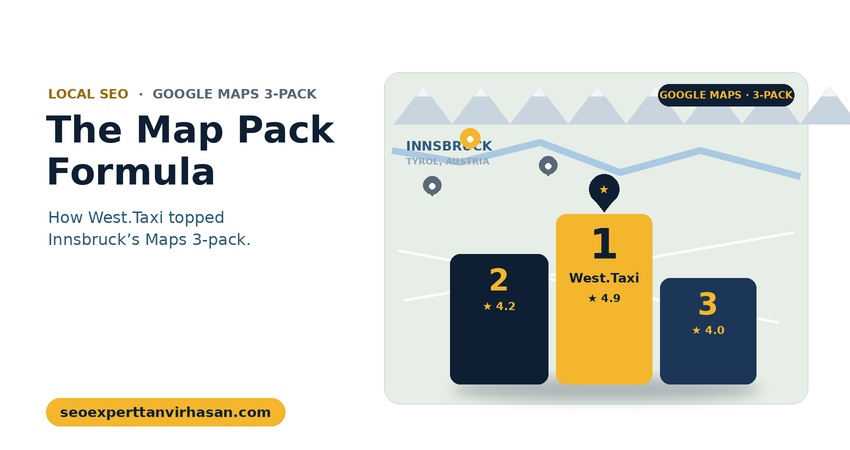
By Part 2, West.Taxi had a fast, schema-rich, bilingual website. But here is a truth every transfer operator learns eventually: for a local taxi business, most bookings aren’t won on your website at all. They’re won in the little box of three businesses Google drops onto a map at the top of the results the Google Maps 3-pack.
There was a twist. West.Taxi’s fleet is based out in Tyrol, yet the searches that matter most — things like “airport shuttle Innsbruck” happen around Innsbruck and its airport. We had to make Google see West.Taxi as an Innsbruck answer while it sat, physically, elsewhere in the region. That is the map pack formula, and it’s more learnable than most owners think. I’m Tanvir Hasan Shawn, a White-hat SEO Expert let’s crack the code.
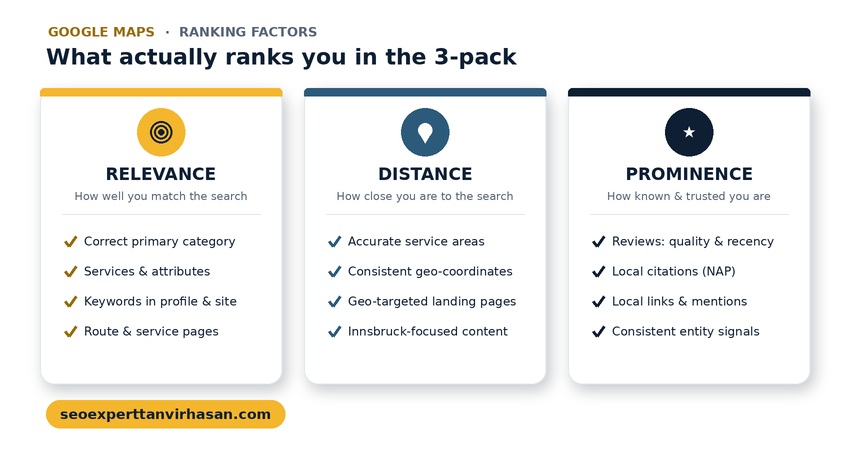
The map pack formula: relevance, distance, prominence
Every Google Maps ranking comes down to three factors, and understanding them turns the 3-pack from a mystery into a checklist:
- Relevance how well your business matches the search. Driven by your primary category, services and the keywords in your profile and on your site.
- Distance how close you are to the searcher or the area they’re searching. You can’t move a mountain resort, but you can define the service areas Google associates you with.
- Prominence how well-known and trusted you are. Built from reviews, local citation building, links, and consistent signals across the web.
You can’t change where a searcher is standing, but you can strongly influence relevance and prominence — and you can shape how Google understands your service area. Every tactic below fits under one of these three levers.
How do I optimize my Google Business Profile for multiple locations?
Quick answer. If you operate across an area rather than from several real storefronts, don’t create multiple listings. Set up one Google Business Profile as a service-area business, define the regions you serve, and optimise that single profile deeply. Genuine separate premises each get their own verified listing; duplicate or fake city listings get suppressed and can trigger a suspension.
West.Taxi is a classic service-area business (SAB): no walk-in storefront, serving customers across Tyrol. So the Google Business Profile optimization looked like this:
- Hid the street address (required for SABs) and instead defined service areas Innsbruck, Innsbruck Airport, Sölden, Ischgl, St. Anton.
- Set the correct primary category (Taxi service) plus relevant secondaries such as Airport shuttle service and Limousine service.
- Completed every field services, attributes, booking links, opening hours, description, and a full set of geotagged photos.
- Kept it active with Google Posts, an answered Q&A, and prompt review replies.
If you genuinely have multiple offices, each real location gets its own profile with its own unique NAP but never spin up listings in cities where you have no true presence. Google’s guidelines are explicit, and the penalty isn’t worth the shortcut.
How do local citations improve Google Maps Pack rankings?
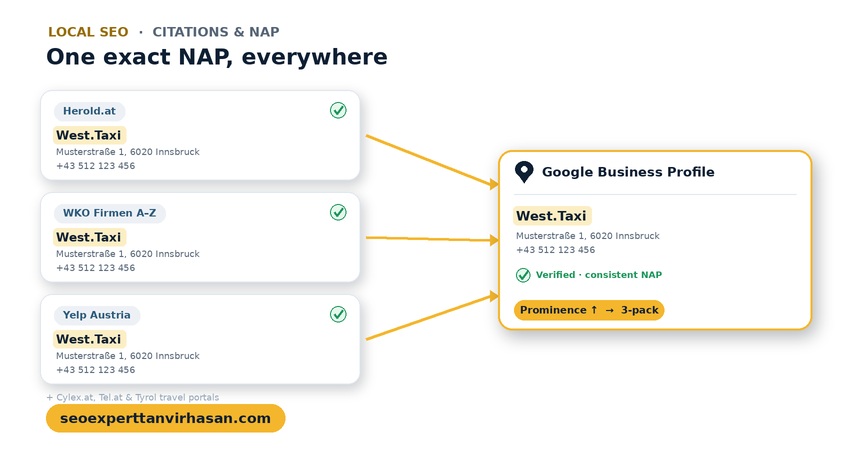
Quick answer. Local citations consistent mentions of your business name, address and phone (NAP) across directories and websites build prominence and confirm your location to Google. Consistent, quality citations raise trust and lift 3-pack rankings; inconsistent or duplicate ones quietly drag them down.
Think of citations as votes of confirmation. Every time an authoritative directory lists West.Taxi with exactly the same details, Google grows more certain the business is real, established, and located where it claims. That certainty is a big part of prominence and prominence is a big part of the pack. Two things matter most: consistency (identical NAP everywhere) and quality (relevant, trusted local and industry sources over spammy volume).
Local citation building in Austria
The citation landscape is country-specific, so “local citation building Austria” means the right Austrian sources, not a generic global list. Our process:
- A full NAP audit first, finding and fixing every mismatched or outdated listing before building new ones.
- Core Austrian directories the major national business directories and maps platforms, listed with identical NAP.
- Local & regional sources Innsbruck and Tyrol directories, tourism portals, and transfer/travel listings relevant to the audience.
- Industry citations taxi, transfer and travel directories that reinforce what the business actually does.
Quality beat quantity throughout. A handful of relevant, authoritative Austrian citations with perfect NAP did far more than hundreds of low-value ones — and left nothing that could be flagged later.
Citations also aren’t a one-time job. New duplicate listings can appear on their own, pulled in by data aggregators, so we set up monitoring to catch and merge or correct them before they fragment the profile’s authority. A clean, consistent citation footprint is something you maintain, not something you finish.
Building Innsbruck authority from a Tyrol base (geo-targeted signals)
This was the real puzzle: ranking for Innsbruck while based elsewhere in Tyrol. The answer wasn’t a trick it was stacking honest geo-targeted SEO signals until Google associated West.Taxi with Innsbruck as strongly as any city-centre operator.
- Service areas set precisely to Innsbruck, its airport and the resort routes travellers search.
- Geo-targeted landing pages dedicated pages for “airport shuttle Innsbruck” and each route, reinforcing the city on the website itself.
- Local links and mentions from Innsbruck entities hotels, ski schools and tourism sites which tie the business to the place in Google’s eyes.
- Location-rich reviews genuine customers mentioning routes (“great transfer from Innsbruck Airport to Sölden”) are among the strongest geo signals there are.
Underneath all of this sits entity SEO: keeping the business name identical everywhere, connecting the profile, website and social accounts with consistent references, and matching geo-coordinates so Google models West.Taxi as a single, trustworthy entity firmly associated with Innsbruck and Tyrol. Managing those localised entity signals is what lets a regional operator win a city’s map pack honestly. We also embedded a Google Map on the contact page, kept the pin and coordinates consistent with the profile, and made sure the Innsbruck-focused pages linked to the routes they described. Individually these are small touches; together they compound into an unmistakable message about where West.Taxi operates which is exactly how a regional fleet earns a city’s trust in the algorithm.

What is the best taxi service in Innsbruck according to Google?
Quick answer. Google doesn’t hand-pick a single “best” taxi. The businesses it shows in the Innsbruck Maps 3-pack are the ones its algorithm rates highest on relevance, distance and prominence usually those with a complete, correctly categorised profile and strong, recent reviews. After this work, West.Taxi became one of them.
It’s worth understanding why this question matters so much now. When a traveller asks a phone or an AI assistant for “the best taxi in Innsbruck,” the answer is pulled straight from the local pack and its reviews. So being seen as “the best” isn’t about claiming it it’s about earning the profile completeness, review strength and consistent signals that put you in the set Google draws its answer from. That is exactly what the map pack formula builds.
The result and what’s next
By the end of this phase, West.Taxi had moved into the Innsbruck Maps 3-pack for its core terms. Profile views, direction requests and calls all climbed the direct, commission-free bookings that come from owning the map rather than renting it from an aggregator.
In Part 4, we deepen the prominence side of the formula with reviews & reputation the ethical review engine that turned first-time passengers into a compounding ranking advantage. But the lesson from cracking the Maps code is this:
In local search you don’t tell Google you’re the best taxi in Innsbruck you give it every honest signal until it concludes that for itself.
If your transport business is invisible on the map in the towns that matter most, that’s fixable. You can book a free visibility audit with me at seoexperttanvirhasan.com.
Google Maps for transport: your questions answered
How do I optimize my Google Business Profile for multiple locations?
If you serve an area rather than run several storefronts, use one profile set up as a service-area business, hide the address, and define your service areas — then optimise that single profile fully. Genuine separate premises each get their own verified listing; never create duplicate or fake city listings, as Google suppresses them and may suspend the profile.
How do local citations improve Google Maps Pack rankings?
Citations are consistent mentions of your name, address and phone across directories and sites. They confirm your location and build prominence — a core Maps ranking factor. Consistent, quality citations from relevant Austrian and industry sources raise 3-pack rankings; inconsistent or duplicate ones weaken them.
What is the best taxi service in Innsbruck according to Google?
Google doesn’t pick one “best” taxi — it shows the businesses its algorithm rates highest on relevance, distance and prominence in the Innsbruck 3-pack, usually those with complete, correctly categorised profiles and strong recent reviews. To be the answer, you have to earn a place in that set.
Can a taxi business rank in a city where it isn’t physically located?
Yes — as a service-area business you can rank in the towns you genuinely serve by defining accurate service areas and stacking honest geo signals: geo-targeted pages, local links and mentions, and location-rich reviews. What you must not do is fake an address or create listings where you have no real presence.
How long does it take to rank in the Google Maps 3-pack?
With a well-optimised profile, consistent citations and a steady flow of genuine reviews, local-pack movement often begins within 4–8 weeks, with stronger positions over three to six months. Competitive city terms take longer than niche route searches.

