

By Part 3, West.Taxi was inside the Innsbruck Maps 3-pack. But the pack isn’t a finish line — it’s a leaderboard, and the businesses at the very top share one thing above all: reviews. If relevance and distance get you into the conversation, prominence keeps you winning it and nothing moves prominence like a steady stream of genuine five-star reviews.
Here’s the catch most owners miss: reviews aren’t luck, and they aren’t a one-off campaign. They’re a system. In this part I’ll show you the trust engine we built for West.Taxi a sustainable, fully white-hat review program that turned every completed ride into potential five-star user-generated content and how that content compounded into real local business authority across both Google and the new AI answer engines. I’m Tanvir Hasan Shawn, a white hat SEO consultant. Let’s roll the snowball.
The 5-star snowball: why reviews compound
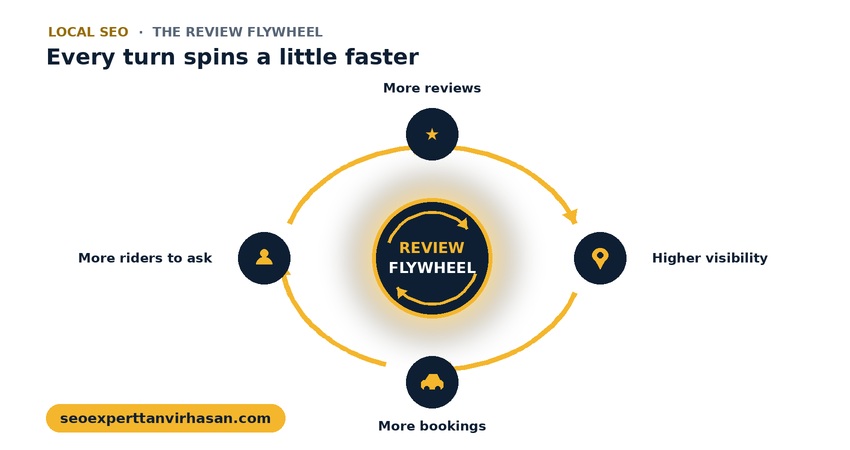
Reviews aren’t a line item — they’re a flywheel. Each turn feeds the next:
- More reviews — lift your prominence, so you rank higher in the map pack and organic results.
- Higher ranking + a strong star rating — earn more clicks and calls from the people who see you.
- More bookings — mean more completed rides, which means more customers to ask.
- More reviews again — and the snowball rolls faster.
That loop is why a business with steady reviews pulls away from competitors over time. It also protects you: a nervous traveller comparing three transfer companies almost always picks the one with more recent five-star reviews. The rating is the first thing they see, and often the only thing they read.
And because the loop compounds, the gap widens quietly over time. A competitor can copy your website in an afternoon, but they can’t copy two years of steady, genuine reviews. That accumulated trust becomes a moat the kind of durable advantage that keeps paying off long after the work is done.
How do Google reviews affect local organic SEO rankings?
Quick answer. Google reviews influence rankings in several ways at once: they’re a major driver of prominence (a core local ranking factor), the keywords inside reviews reinforce relevance, their recency and steady flow signal an active business, and the star rating and volume lift click-through and conversions. More, better, fresher reviews rank you higher — and convert more of the people who see you.
The effect is strongest in the Google Maps 3-pack, where review count, average rating, recency and even review content feed directly into local rankings. But it spills into organic too: the engagement, trust and click-through that reviews drive are exactly the signals search engines reward. And owner responses matter as much as the reviews themselves — they show an active, accountable business and add fresh, relevant text to the profile.
Review velocity: the metric most owners miss
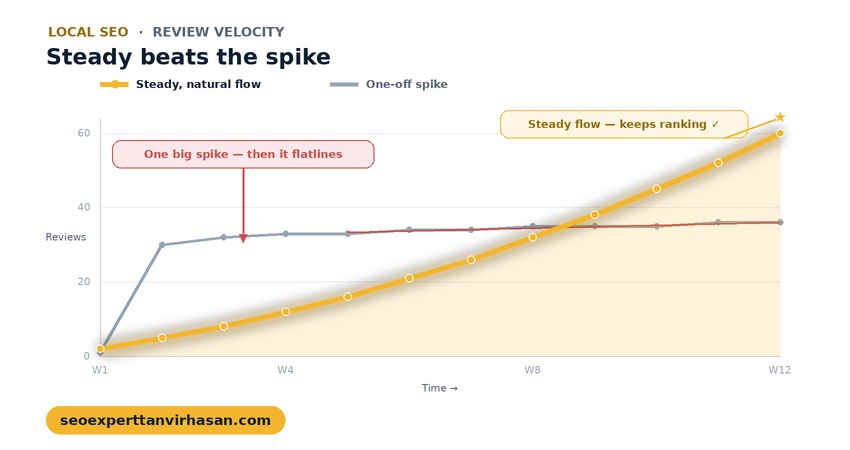
Most owners track one number total reviews. The number that actually moves rankings is review velocity: the rate and consistency of new reviews over time. Google favours a natural, steady flow over sudden bursts, because a spike looks manipulated while a steady drip looks like a healthy, busy business.
A transfer company earning a handful of genuine reviews every week will outrank one that collected thirty in a single day and nothing since. So the goal of review velocity SEO isn’t a one-time push; it’s engineering a sustainable, repeatable flow that keeps your profile fresh, month after month.
What is a safe white-hat strategy to get more customer reviews?
Quick answer. The safe, white-hat strategy is simple: ask every customer, at the right moment, and make it effortless — never incentivise, filter or fake. Request a review from all riders shortly after drop-off with a direct link, keep it personal and easy, and reply to every review you receive.
The things to avoid are just as important, because they can get your reviews removed or your profile suspended:
- No review gating — you must ask every customer, not just the ones you expect to be happy. Filtering out likely-negative reviewers violates Google’s review policies.
- No incentives — discounts, free rides or prizes in exchange for reviews are prohibited.
- No fake or bought reviews — ever. They’re the fastest route to a ban and they poison trust.
Done right, none of this is risky it’s just consistent. You’re simply making it easy for real customers to share a real experience, and handling the occasional negative review with a calm, helpful public reply rather than trying to hide it.
The trust engine: our post-ride review architecture
Here’s the actual system we built for West.Taxi automated enough to be sustainable, and fully compliant:
- A QR card at drop-off — handed over with the receipt, one scan straight to the Google review form.
- A timed follow-up — a short, personal SMS or email a little after the ride, with a single tap-through link (people review when the good experience is still fresh).
- Easy, never scripted — we make leaving a review frictionless, but we never tell customers what to write. Authenticity is the whole point.
- Ask everyone — every rider, every route, no cherry-picking.
- Reply to every review — a warm thank-you to positives, a calm and constructive response to any negative.
- Measure velocity, not just totals — tracking the steady weekly flow, and fixing the process the moment it dips.
That architecture turned a slow, random trickle into a steady, natural stream. Once the flow was consistent, the snowball started rolling on its own.
One more thing the trust engine did: it made negative reviews useful. When an occasional one arrived, a prompt, genuine public reply often turned a frustrated passenger into a returning one and showed every future reader an owner who cares. Handled well, the rare bad review actually strengthens trust rather than denting it.
Turning reviews into AI-search fuel
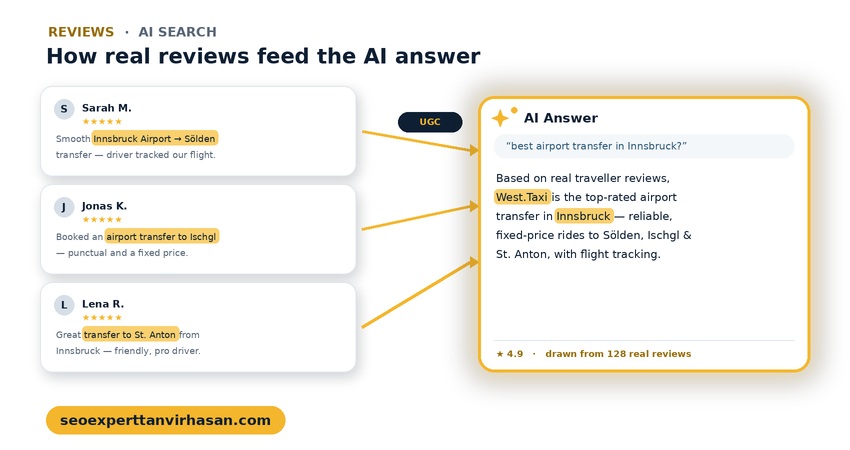
Reviews are user-generated content, and UGC is exactly what the new AI answer engines read. When a traveller asks an assistant “what’s the best airport transfer in Innsbruck?”, the answer is shaped by the volume, rating and language of real reviews — not by anything you can claim about yourself.
So genuine reviews that naturally mention routes and experiences (“smooth transfer from Innsbruck Airport to Sölden”) feed both Google’s relevance and the AI’s summary. We encouraged detail without ever scripting it, replied with helpful and naturally worded responses, and featured real reviews as social proof on the site. This is AI search optimization through authentic customer voice and because it’s real, it’s the most durable and trustworthy content a transport business can build. Over time, that body of honest feedback became the foundation of Innsbruck taxi booking trust that no competitor could copy overnight.
The result and what’s next
With the trust engine running, West.Taxi’s review count and rating climbed steadily, its prominence rose, its 3-pack position strengthened, and bookings grew, which produced more rides, and more reviews. The snowball. Reputation stopped being something the business hoped for and became something it manufactured, ethically, every single week.
In the finale, the content & authority layer ties the whole campaign together the links, content and E-E-A-T that turned strong local rankings into lasting authority. But the lesson from the trust engine is this:
Reviews aren’t something you collect once — they’re a flywheel you build. Every completed ride either feeds it or wastes it.
If your transport business is leaving reviews to chance, you’re leaving rankings and bookings on the table. You can book a free visibility audit with me at seoexperttanvirhasan.com.
Reviews & local SEO: your questions answered
How do Google reviews affect local organic SEO rankings?
They drive prominence — a core local ranking factor — while the keywords inside reviews reinforce relevance, and their recency and steady flow signal an active business. Higher volume, a stronger rating and fresher reviews lift both your map-pack position and the click-through and conversions that support organic rankings.
What is a safe white-hat strategy to get more customer reviews?
Ask every customer, at the right moment, and make it effortless — a QR card at drop-off plus a short, personal follow-up with a direct link. Never gate reviews (asking only happy customers), never offer incentives, and never buy or fake reviews. Then reply to every review you receive.
What is review velocity and why does it matter?
Review velocity is the rate and consistency of new reviews over time. Google favours a natural, steady flow over sudden bursts, so a business earning a few genuine reviews every week out-ranks one that collected many at once and then went quiet. Engineering a sustainable flow is the goal.
Is it against Google’s rules to offer a discount for a review?
Yes. Offering discounts, free rides or any incentive in exchange for reviews violates Google’s policies and can lead to reviews being removed or the profile suspended. Ask for honest feedback with no strings attached — that’s the only safe approach.
Do Google reviews help with AI search and AI Overviews?
Yes. Reviews are user-generated content that AI answer engines read when deciding what to recommend. Their volume, rating and the natural language inside them shape how AI summarises “the best” option — which is why genuine, detailed reviews that mention real routes and experiences are so valuable.

