

From Pay-Per-Click Dependency to Organic Dominance: The West.Taxi Revenue Shift
Before we overhauled their search architecture, West.Taxi was trapped in a financial treadmill familiar to thousands of transport business owners across Europe and North America. Every single airport transfer booked from Munich Airport or Innsbruck Airport to the ski resorts of the Tyrolean Alps came at a steep price. They were forced to bid endlessly on high-cost paid search ads or hand over 20% to 30% commission rates to third-party travel aggregators and booking platforms. The moment they paused their advertising spend, their dispatch calendar went completely cold. They didn’t own a predictable customer acquisition engine; they were renting one at exorbitant rates.
Fast forward twelve months after executing our white-hat local SEO, review velocity engine, and AI search architecture. West.Taxi didn’t just climb into the Innsbruck Maps 3-Pack; they fundamentally captured the market for high-intent search terms like “Taxi Transfer in Innsbruck,” “airport taxi Innsbruck to St. Anton,” and “private transfer Innsbruck Airport.” Instead of paying for every single click, their digital presence transformed into a high-yielding asset that generates direct, commission-free ride bookings around the clock.
What happens to a transport business when you transition from buying traffic to permanently owning top-of-funnel local visibility? The economics of the business instantly transform. Profit margins expand because customer acquisition costs drop dramatically. Fleet utilization skyrockets because high-value pre-booked airport transfers fill the dispatch schedule weeks in advance. Most importantly, the brand builds a compounding moat: every satisfied rider leaves another five-star review, which further cements their top position in both Google Maps and generative AI search engines.
The West.Taxi Transformation: Measuring the Metrics That Drive Profit
In local transport SEO, vanity metrics like impressions and generic keyword ranks mean nothing if they do not translate into dispatched vehicles and bankable revenue. During our campaign for West.Taxi, we aligned every technical optimization, city landing page, and schema deployment with concrete financial KPIs.

1. Organic Search Traffic & High-Intent Visibility
Over a 12-month period, organic website sessions for West.Taxi grew by 310% year-over-year. More importantly, over 70% of this new organic traffic arrived through high-intent long-tail phrases (e.g., “Innsbruck airport taxi to Ischgl transfer”) rather than broad, low-converting terms.
2. Direct Online Bookings & Phone Call Conversions
By implementing frictionless booking forms, tap-to-call mobile buttons, and structured FAQ sections, the website’s overall conversion rate jumped from a modest 3.2% to 18.4%. Phone calls initiated directly from their Google Business Profile increased by 245%, providing a continuous stream of immediate ride requests during peak travel seasons.
3. Drastic Reduction in Customer Acquisition Cost (CAC)
With a steady flow of organic and AI-assisted ride bookings coming in daily, West.Taxi systematically reduced their paid pay-per-click (PPC) ad spend by 65%. The revenue previously lost to ad platforms and booking aggregators was redirected straight back into fleet expansion and business reserves.
Tracking What Matters: The Local Transport Conversion Framework
To duplicate the West.Taxi results, transport operators must move beyond basic Google Analytics views and build a dedicated local conversion tracking loop. If you cannot pinpoint precisely which search route or map interaction generated a €200 airport transfer, you cannot optimize your growth.
A comprehensive tracking framework for a taxi business requires three core components:
- Dynamic Call Tracking: Implementing call tracking numbers on your website and Google Business Profile to isolate calls originating specifically from local search users.
- Form & Booking Engine Event Tracking: Configuring Google Analytics 4 (GA4) custom event triggers every time a user completes a pickup/dropoff booking request or submits a fare inquiry.
- Google Business Profile Insight Integration: Tracking primary user actions—including “Clicks to Website,” “Driving Directions Requested,” and “Direct Phone Calls”—to evaluate Map Pack health month over month.
By tying these conversion events directly to Google Search Console query data, we identified that long-distance airport transfers were West.Taxi’s most profitable service. This insight allowed us to double down on specialized route pages, driving their highest-margin business line through organic search.
Demystifying the ROI of Local Transport SEO
When business owners evaluate an SEO investment, the most common question they ask is: “What is the actual return on investment, and how quickly does it pay for itself?”
Unlike paid search advertising, where revenue stops the instant you stop paying for clicks, local SEO operates like a compounding financial asset. The upfront investment in domain authority, custom route architecture, schema markup, and review automation builds a durable foundation that continues to generate bookings for years to come.

Long-Term Defense: How to Permanently Maintain Top 3 Rankings
Reaching the top of Google Maps and organic search is a major milestone, but holding that position against aggressive competitors requires a proactive maintenance strategy. Search algorithms evolve, new competitors enter the market, and review velocity can naturally decline if neglected.
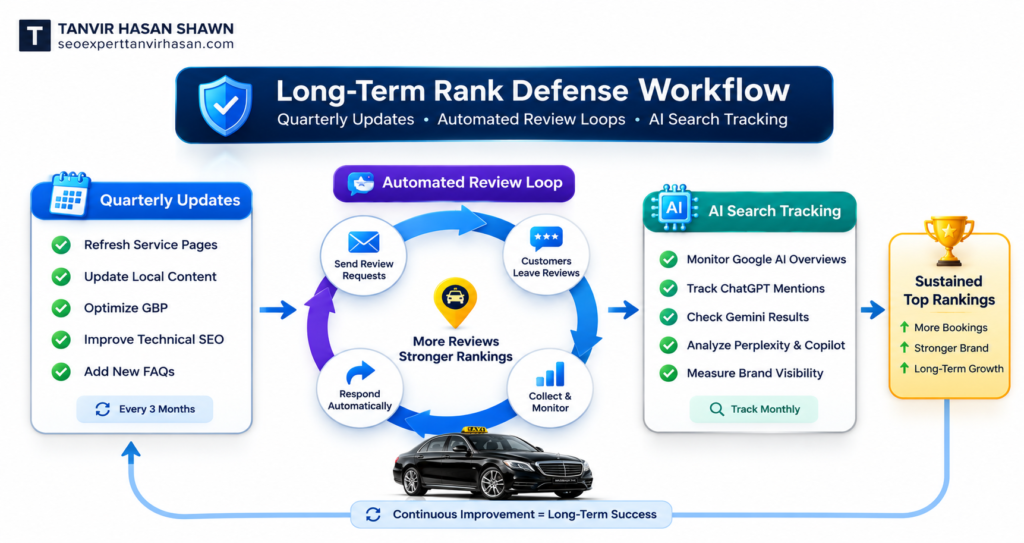
To defend West.Taxi’s position at the top of the Innsbruck market, we established a streamlined, 3-pillar ranking maintenance workflow:
1. Sustained Review Velocity Engine
A common mistake business owners make is stopping review requests once they hit the #1 spot. Google’s algorithm heavily weights review recency and consistency. By keeping West.Taxi’s automated SMS/email post-ride review triggers active, we ensured a continuous trickle of 3 to 5 genuine customer reviews every week, signaling ongoing operational excellence to search crawlers.
2. Quarterly Technical & Content Refresh
Search engines favor fresh, accurate content. Every quarter, perform a quick content audit: update local fare guidelines, refresh driver profiles, add new customer FAQs, and test mobile booking form load speeds to ensure your site continues to pass Core Web Vitals benchmarks with flying colors.
3. Active Google Business Profile Engagement
Treat your Google Business Profile like a real-time publishing platform. Upload fresh photos of your clean vehicles monthly, post weekly updates about seasonal travel routes or airport transfer tips, and respond promptly to all incoming customer reviews and Q&As.
The AI Search Horizon: Preparing Your Brand for GEO Dominance
As generative AI platforms like ChatGPT, Gemini, Perplexity, and Google AI Overviews handle a larger share of travel planning, maintaining top local rankings requires adapting to Generative Engine Optimization (GEO).
AI answer tools do not simply pick the business with the most backlinks; they recommend the brand that possesses the strongest online consensus across multiple data sources. Because West.Taxi built a comprehensive digital footprint—complete with validated TaxiService schema, consistent local directory citations, detailed route guides, and hundreds of verified reviews describing specific trips—AI search engines consistently cite West.Taxi as the primary recommended transfer provider in the Innsbruck region.
By executing the white-hat strategies detailed throughout this 5-part series, you aren’t just optimizing for today’s search engines. You are future-proofing your transport business so that whenever a traveler asks an AI assistant for a ride, your fleet is the one called to duty.

Summary of Strategic Priorities for Business Scale
To turn your local SEO strategy into a long-term business scaling engine, keep these operational priorities top of mind:
- Conversion Optimization First: Traffic without conversions is wasted potential. Always prioritize fast mobile load speeds, clear pricing structures, and tap-to-call functionality above raw traffic metrics.
- USA Business Focus: Focus heavily on capturing long-distance airport routes, corporate travel contracts, and event shuttle demand. Ensure seamless integration with mobile wallets (Apple Pay, Google Pay) to maximize conversion rates.
- European Business Focus: Capitalize on multi-currency support, multi-language landing pages for international tourists, and highlighted eco-friendly/EV options to cater to sustainability-minded European travelers.
- E-E-A-T Commitment: Never compromise on white-hat practices. Sustainable growth relies on authentic customer feedback, real fleet photography, and transparent business operations that search engines can comfortably trust.
FREQUENTLY ASKED QUESTIONS
What is the average ROI of a local SEO campaign for a taxi service?
While results vary based on fleet size and market competition, a well-executed local SEO campaign for a transport company typically yields a 500% to 1,000%+ ROI within 12 to 18 months. By capturing high-intent searches organically, you eliminate heavy commission fees from third-party aggregators and reduce reliance on expensive pay-per-click advertising.
How do you maintain top 3 Google Maps rankings after an SEO campaign ends?
To maintain top rankings permanently, keep your review automation active to ensure a steady flow of genuine customer feedback, post monthly updates and photos to your Google Business Profile, refresh your website’s route content quarterly, and monitor your technical site health to ensure mobile page speeds remain fast.
How long does it take to see a noticeable increase in direct ride bookings from local SEO?
Initial visibility improvements in the Google Map Pack often appear within 30 to 60 days. However, compounding growth in direct online bookings and call volume typically accelerates between months 3 and 6 as your domain authority builds and new route landing pages are indexed and ranked.
Can local SEO reduce my taxi company’s dependence on Google Ads and third-party booking apps?
Yes. One of the greatest financial benefits of local SEO is replacing rented traffic with owned visibility. As your business secures organic rankings in the Map Pack and standard search results, you can systematically taper off your paid ad spend while maintaining or increasing your total booking volume.
Why is conversion tracking so critical for transport SEO?
Conversion tracking connects your marketing efforts directly to revenue. By tracking mobile phone calls, form submissions, and direct online booking engine completions, you can identify exactly which airport routes and search terms generate your highest-margin customers, allowing you to double down on what drives real profit.

