
There’s a particular frustration I hear from transport business owners all over Europe: “We’re good at what we do reliable drivers, clean cars, fair prices so why isn’t the phone ringing from Google?” When West.Taxi, a licensed airport-transfer operator in Innsbruck, came to me, that was the exact question on the table.
For their most valuable search the one that turns into a paid airport run they were stuck on page four of Google. And page four, commercially, is invisible. Innsbruck’s best transfer leads were quietly going to competitors and international booking aggregators instead.
This is Part 1 of a case-study series I call The Diagnostics & The Blueprint. Before we could move West.Taxi from page four to the top three, we had to do the thing most agencies skip find out exactly why they were stuck. Not a guess, not a generic checklist: a real diagnosis. Here’s the day we ran it, what we found, and how it became the blueprint for everything that followed. I’m Tanvir Hasan Shawn, a White Hat SEO Expert let’s open the hood.
Why is my transport website not getting online bookings?
Quick answer. A transport website usually isn’t getting online bookings because it’s invisible at the moment of intent it doesn’t rank for the searches customers actually use, its Google Business Profile isn’t competing in the Maps 3-pack, and the few visitors who do arrive hit a page that doesn’t make booking obvious. Bookings leak away in three places: visibility, trust, and conversion.
When I diagnose a taxi or transport site that isn’t turning searches into bookings, the cause is almost always some mix of these:
- It doesn’t rank for high-intent local searches: the route-based and airport-based queries that signal someone ready to book.
- The Google Business Profile is unoptimised: so it never enters the Google Maps 3-pack, where most local transport bookings actually happen.
- The site is slow on mobile: where nearly every last-minute transfer is booked, often from the arrivals hall.
- There’s no clear price, route, or booking action: so even interested visitors give up and tap a competitor.
- Weak reviews and inconsistent business details: which quietly destroy the trust a stranger needs before paying for a ride.
For West.Taxi, it was all five to some degree. The good news: every one of them is fixable and a proper audit tells you which to fix first.
When we started: where West.Taxi actually stood
Before touching anything, I measured the baseline honestly. On day one, the picture looked like this:
- The money keyword “taxi transfer in Innsbruck” sat on page four, far below the fold of demand.
- The Google Business Profile was live but dormant: wrong primary category, thin services, barely any photos, and no presence in the local map pack.
- The website was thin and slow on mobile, with no dedicated pages for the specific airport-to-resort routes travellers search.
Business details (name, address, phone) were inconsistent across directories, and the review base was small and slow-growing.
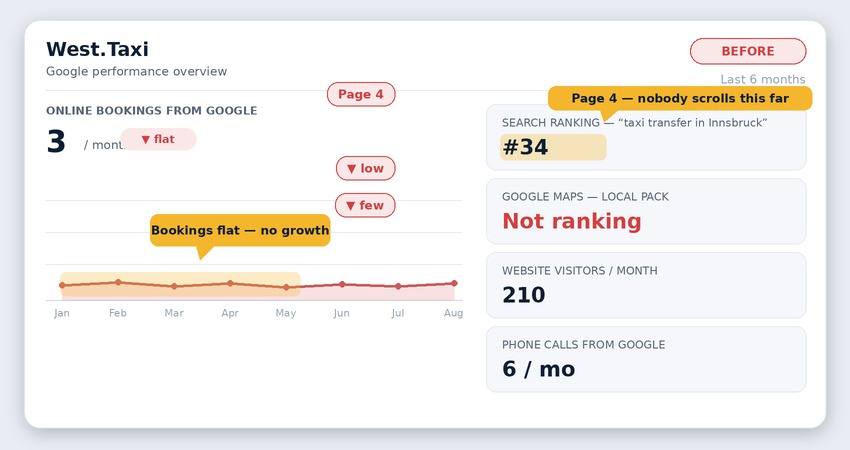
None of this was a reflection of the service quality West.Taxi was a genuinely good operator. It was purely a visibility and trust problem online. That distinction matters, because it means the fix is an SEO problem, not a business problem.
The initial audit: a full local SEO diagnosis
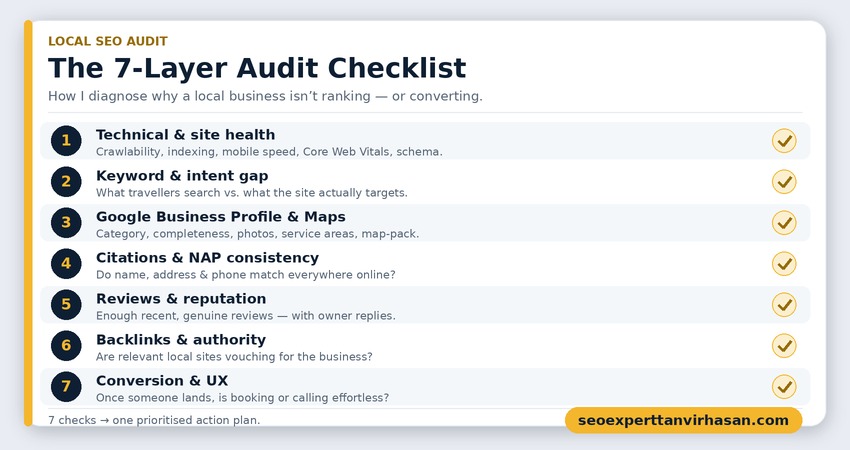
A real local SEO audit isn’t a five-minute score from a free tool. It’s a systematic diagnosis across seven layers, each answering a specific question about why the business isn’t ranking or converting:
- Technical & site health — can Google crawl, render and index the site quickly on mobile? Core Web Vitals, indexation, HTTPS, structured data.
- Keyword & intent gap — what are travellers actually searching, and does the site target those exact intents? (It didn’t.)
- Google Business Profile & Maps — is the profile complete, correctly categorised, and competing in the 3-pack?
- Citations & NAP consistency — do the business details match everywhere they appear online?
- Reviews & reputation — enough recent, genuine reviews, with owner replies?
- Backlinks & authority — are relevant local sites vouching for the business?
- Conversion & UX — once someone lands, is booking or calling effortless?
To run it I used Google Search Console and Google Analytics 4 for the site’s real data, Screaming Frog and PageSpeed Insights for the technical layer, Ahrefs for keyword and competitor gaps, and BrightLocal for citation and map-pack checks. The audit turned a vague “we’re not getting bookings” into a precise, prioritised list of causes.
How do I rank my taxi business on Google Maps?
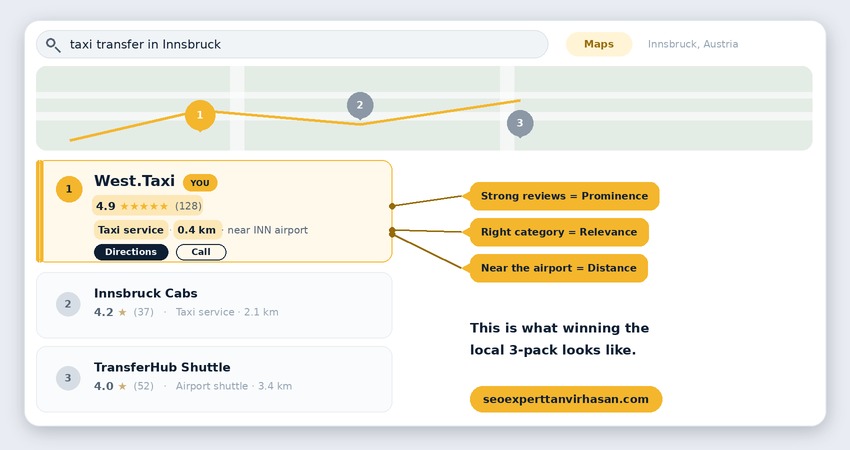
Quick answer. You rank a taxi business on Google Maps by maximising the three signals the local algorithm weighs relevance, distance, and prominence. In practice: choose the correct primary category, complete every field of your Google Business Profile, keep your name, address and phone identical everywhere, and earn a steady flow of genuine reviews you reply to.
Breaking that down into the levers that actually moved West.Taxi:
- Relevance — the right primary category (Taxi service), accurate services and service areas, and a website whose route landing pages reinforce what the profile claims.
- Distance — clearly defined service areas around Innsbruck Airport and the resorts, so Google matches the business to nearby searches.
- Prominence — reviews, consistent citations, and local links that tell Google this is a real, trusted, established operator.

This is also why a great website alone rarely fixes a transport business’s bookings: for local, mobile, last-minute searches, the Google Business Profile and the map pack often decide the booking before anyone reaches your site at all.
Identifying the market gaps (where the opening was)
Diagnosis isn’t only about your own weaknesses it’s about the market’s openings. So I studied who was winning Innsbruck’s transfer searches and why, and where they were beatable.
Two patterns stood out. First, the big aggregators and ride-hailing apps dominated broad, generic terms but they handled specific routes generically, with no local detail, no fixed local pricing, and no real Google Business Profile presence for Innsbruck. Second, the seasonal, tourist-driven, multilingual (English and German) nature of the market meant precise, route-based, bilingual pages were badly underserved.
That was the gap: West.Taxi couldn’t out-spend a global app, but it could absolutely own searches like “airport transfer to Sölden” or “Innsbruck to Ischgl taxi” high-intent, low-competition, and exactly the leads worth having. Market gap analysis is how a smaller local business wins without a bigger budget.
From diagnosis to blueprint
With the audit and market analysis done, the strategy almost wrote itself. Every finding mapped to a prioritised action, in the order that compounds fastest:
- Fix the technical foundation so the site is fast, crawlable and understood.
- Rebuild the Google Business Profile to enter the Maps 3-pack the fastest path to bookings.
- Build route landing pages that match the exact searches travellers use.
- Align citations and grow genuine reviews to build local trust.
- Earn local authority through real partnerships and content.
That sequence is the blueprint — and it’s what carried the money keyword from page four into the top three, with the map-pack visibility and booking calls that came with it. In Part 2, I’ll show you the first build: the technical fixes and the route landing pages that gave West.Taxi a foundation strong enough to rank.
A guess tells you what to try. A diagnosis tells you what to fix — and in what order. That’s the whole difference between SEO that works and SEO that burns budget.
If your transport or taxi website isn’t pulling the bookings your service deserves, the first step is the same one West.Taxi took — a proper diagnosis. You can book a free visibility audit with me at seoexperttanvirhasan.com.
How do I rank my taxi business on Google Maps?
Maximise the three local ranking signals — relevance, distance and prominence. Set the correct primary category (Taxi service), complete your Google Business Profile, define your service areas, keep your name/address/phone identical across the web, and earn steady genuine reviews you reply to. Reinforce it all with route-specific pages on your website.
Why is my transport website not getting online bookings?
Usually because it’s invisible at the moment of intent: it doesn’t rank for the local, route-based searches customers use, the Google Business Profile isn’t in the Maps 3-pack, the site is slow on mobile, or the booking action isn’t obvious. Bookings are lost across three areas — visibility, trust and conversion — and a local SEO audit shows which to fix first.
How long does it take to rank a taxi or transport business locally?
In competitive European markets, expect early movement in three to four months and strong top-five and map-pack rankings around the six-month mark, when the work is white hat and consistent. Map-pack gains from a well-optimised Google Business Profile often show first.
What is a local SEO audit and what does it include?
A local SEO audit is a systematic diagnosis of why a local business isn’t ranking or converting. It covers technical site health, keyword and intent gaps, Google Business Profile and Maps, citation/NAP consistency, reviews, backlinks and authority, and on-site conversion — ending in a prioritised action plan.
Should transport companies rely on Uber, Bolt or aggregators for bookings?
They’re useful for fill-in demand, but they take a commission on every ride and own the customer relationship. Ranking your own website and Google Business Profile earns direct, commission-free bookings and repeat customers you keep — which is why owning your local search is worth the investment.

