
By the time we sat down to rebuild West Taxi’s Google Business Profile, we’d already done the hard research from Part 1: a full keyword map of every service and location worth targeting, and a competitor audit showing exactly where the market was weak. And yet West Taxi still wasn’t consistently appearing in Innsbruck’s Map Pack because none of that groundwork had been reflected in the one asset Google leans on most.
That asset is the Google Business Profile, and rebuilding it properly is what finally closed the gap. This opens Part 2 of the series the single move most local SEO guides mention in passing, and the one we treat as the centerpiece it actually is.
What Is the Most Important Step to Rank a Taxi Business Locally?
Quick answer. Claiming and fully optimizing your Google Business Profile (GBP) is the single highest-impact move for any taxi service. This free listing is what powers your spot in the Map Pack and on Google Maps. A complete, active, well-reviewed profile can outrank competitors with bigger websites because the Map Pack, where most ride bookings originate, is driven almost entirely by profile signals, not by domain authority or web design budget.
This is genuinely good news for small and independent taxi operators. You don’t need to outspend a national transport brand on web development to outrank them locally. You need a more complete, more accurate, and more actively maintained Business Profile than theirs and that’s within reach of literally any owner-operated taxi business willing to put in the work.
Why the Business Profile Outweighs Almost Everything Else
Recall the three ranking signals from earlier in this series: relevance, distance, and prominence. A well-built Google Business Profile touches all three at once. Your categories and services establish relevance. Your service-area settings establish distance. Your reviews, photos, posts, and completeness establish prominence. No other single asset not your website, not a single backlink, not a social media page influences all three signals simultaneously the way your profile does.
It’s also the asset searchers actually interact with first. A traveler searching “airport taxi near me” sees your Map Pack card hours, rating, photos, call button before they ever click through to a website. If that card is incomplete, outdated, or generic, you lose the booking before your website even gets a chance to make its case.
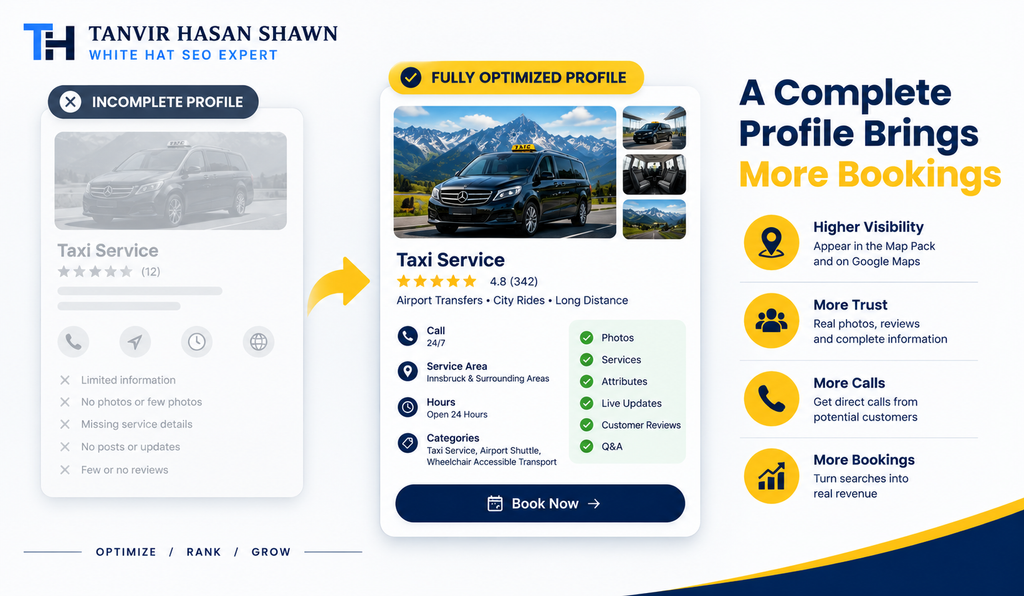
The Anatomy of a Fully Optimized Taxi Business Profile
Business Name: Accurate, Never Stuffed
Use your real, registered business name exactly as it appears on your signage and paperwork. Resist the temptation to add keywords like “Cheapest” or “Best Airport Transfer” into the name field this is a direct violation of Google’s guidelines and one of the fastest ways to trigger a suspension.
Categories: Primary and Secondary
This is where your keyword map from Part 1 pays off directly. Select the most accurate primary category (“Taxi Service” or “Airport Shuttle Service,” depending on your core offering), then add every relevant secondary category your business genuinely supports wheelchair-accessible transport, corporate transportation, or courier service, if applicable.
Service Areas: Honest and Specific
Enter the towns, neighborhoods, and zones from your Part 1 service-area work, not an aspirational radius. An accurate, well-defined service area concentrates your ranking signals where they count.
Hours, Including Special Hours
Keep standard hours accurate, and don’t skip holiday or special hours a taxi business showing as “closed” on New Year’s Eve because nobody updated the holiday schedule loses exactly the bookings that matter most.
Attributes and Services List
Fill in every applicable attribute: 24-hour availability, wheelchair accessibility, credit card payment, online booking. Each one is a small relevance signal, and together they paint a complete picture Google can match to specific searches.
Photos: Real, Recent, and Frequent
Upload real photos of your actual vehicles, drivers (with consent), and pickup points, not stock imagery. Add new photos regularly; a profile that hasn’t added a photo in eight months signals neglect, exactly the kind of gap we flagged when auditing competitors in Part 1.
Business Description
Write a natural, keyword-aware description that mentions your core services and service area without stuffing for example, describing your airport transfer coverage, your response times, and what makes your service reliable, in plain language a rider would actually read.
The Q&A Section
Most taxi owners never touch this section, which means most competitors haven’t either. Proactively seed it with the questions riders actually ask: “Do you offer fixed-price airport transfers?” “Is your fleet wheelchair-accessible?” “Do you operate overnight?”
Posts and Updates
Weekly posts a seasonal offer, a service reminder, a note about holiday availability signal an actively managed profile, one of the clearest prominence indicators available to any business, regardless of size.
The Booking or Website Link
Make sure your “Book Online” or website link goes directly to a page that lets a rider act immediately, ideally the exact service page matching the keyword that brought them there, not a generic homepage.
A Real Local Scenario: Two Businesses, One Winner
Picture two taxi companies operating in the same mid-sized American city call them similar in fleet size, similar in price, similar in location. One has a Business Profile with a generic description, five-year-old photos, no listed attributes, and a service area that vaguely covers “the metro area.” The other has current photos, a full attribute list, an accurate service area, and weekly posts. When a traveler searches “airport taxi near me,” Google has almost nothing to differentiate the first business but a clear, complete relevance and prominence signal from the second. This exact dynamic plays out identically whether the city is Denver, Manchester, Lyon, or Vancouver completeness wins over size, every time.
Warning: Never create a second Google Business Profile for the same location to “start fresh” after a suspension or a bad review streak. Duplicate listings violate Google’s guidelines directly and typically suppress both profiles rather than helping either one.
What Does a Full GBP Rebuild Cost?
Claiming and optimizing a Google Business Profile is entirely free there is no fee to Google for any part of this process. The real investment is time: a thorough first-time rebuild, done properly with real photos and a complete attribute list, typically takes two to four hours for a single-location taxi business. Ongoing maintenance weekly posts, review responses, periodic photo updates is closer to twenty to thirty minutes a week. Compared to any paid advertising channel, this is the highest return-on-time local SEO move available to a taxi business of any size.
Keeping Your Profile Ranked: A Monthly Maintenance Checklist
- Add at least one new, real photo
- Post at least one update or offer
- Review and update hours, including any upcoming holidays
- Respond to every new review, positive or negative
- Add any newly answered questions to the Q&A section
- Re-check category and attribute accuracy as your services evolve
What’s Next in Part 2
A fully built profile is the foundation but a foundation still needs upkeep and reinforcement. The next post in Part 2 goes deeper into the specific fields most taxi owners underuse attributes, posts, and the Q&A section turning a “complete” profile into an actively compounding one. If you’d like a professional review of your current Business Profile before then, you can book a free visibility audit with me at seoexperttanvirhasan.com.
FREQUENTLY ASKED QUESTIONS
What is the single most important thing I can do to rank my taxi business on Google?
Claim and fully optimize your Google Business Profile. It’s free, it directly powers your placement in the Map Pack and Google Maps, and a complete, active, well-reviewed profile can outrank competitors with far bigger websites and marketing budgets.
How long does it take to fully optimize a Google Business Profile for a taxi business?
A thorough first-time setup with accurate categories, real photos, a complete attribute list, and a written description typically takes two to four hours. After that, ongoing maintenance is closer to twenty to thirty minutes a week.
Does my Google Business Profile matter more than my website for local ranking?
For Map Pack placement, yes the Map Pack is driven mainly by your Business Profile. Your website still matters for organic rankings and for converting research-stage visitors, but for most direct taxi bookings, the profile is the higher-impact asset.
What happens if I list an inaccurate service area on my Google Business Profile?
Claiming coverage you can’t realistically fulfill sends a mismatch signal that can damage trust and suppress rankings across your entire profile, not just for the overreaching area. An accurate, honest service area consistently outperforms an inflated one.
Should I create a new Google Business Profile if my current one isn’t ranking well?
No. Creating a duplicate listing for the same location violates Google’s guidelines and typically suppresses both profiles. Instead, audit and rebuild your existing profile using the steps in this guide.

